
What It’s Like to Stay in a Countryside Ryokan
By Kai Howe
A ryokan is a traditional Japanese inn. The word can describe everything from an elegant hot-spring resort with private baths and elaborate multi-course meals to a small family-run guesthouse in a rural town.
This article is about the second kind: the modest countryside ryokan that may not appear near the top of a Google search, may not have an English website, and may still expect you to make a reservation over the phone.
These places are rarely luxurious, but they can offer one of the most genuine and memorable accommodation experiences in Japan.
A typical countryside ryokan is often an older building with wooden corridors, sliding doors, and rooms covered in tatami (woven straw mat) flooring. You normally remove your shoes at the entrance and change into slippers before being shown to your room.
The room itself may feel surprisingly simple. There is usually a low table, floor cushions, a television, and a small alcove displaying flowers, artwork, or a hanging scroll. Instead of a permanent bed, you sleep on a futon laid directly on the tatami.
At some ryokan, the staff will prepare the futon while you are having dinner. At smaller places, you may unfold it yourself at night and put it away again in the morning. The room changes with the time of day: a sitting room in the afternoon, a bedroom at night, and an open space again after breakfast.
There will probably be a television in the corner showing regular Japanese channels. In the evening, you might find yourself sitting on the floor in a yukata (light cotton robe), watching a variety show, baseball game, or local news programme without fully understanding what is being said. It is a small detail, but it often becomes part of the experience.
Meals are one of the main reasons to stay at a ryokan.
Many countryside ryokan offer plans that include both dinner and breakfast, although some allow you to book a room without meals. At smaller family-run properties, the food is often prepared by the owners themselves rather than by a large professional kitchen.
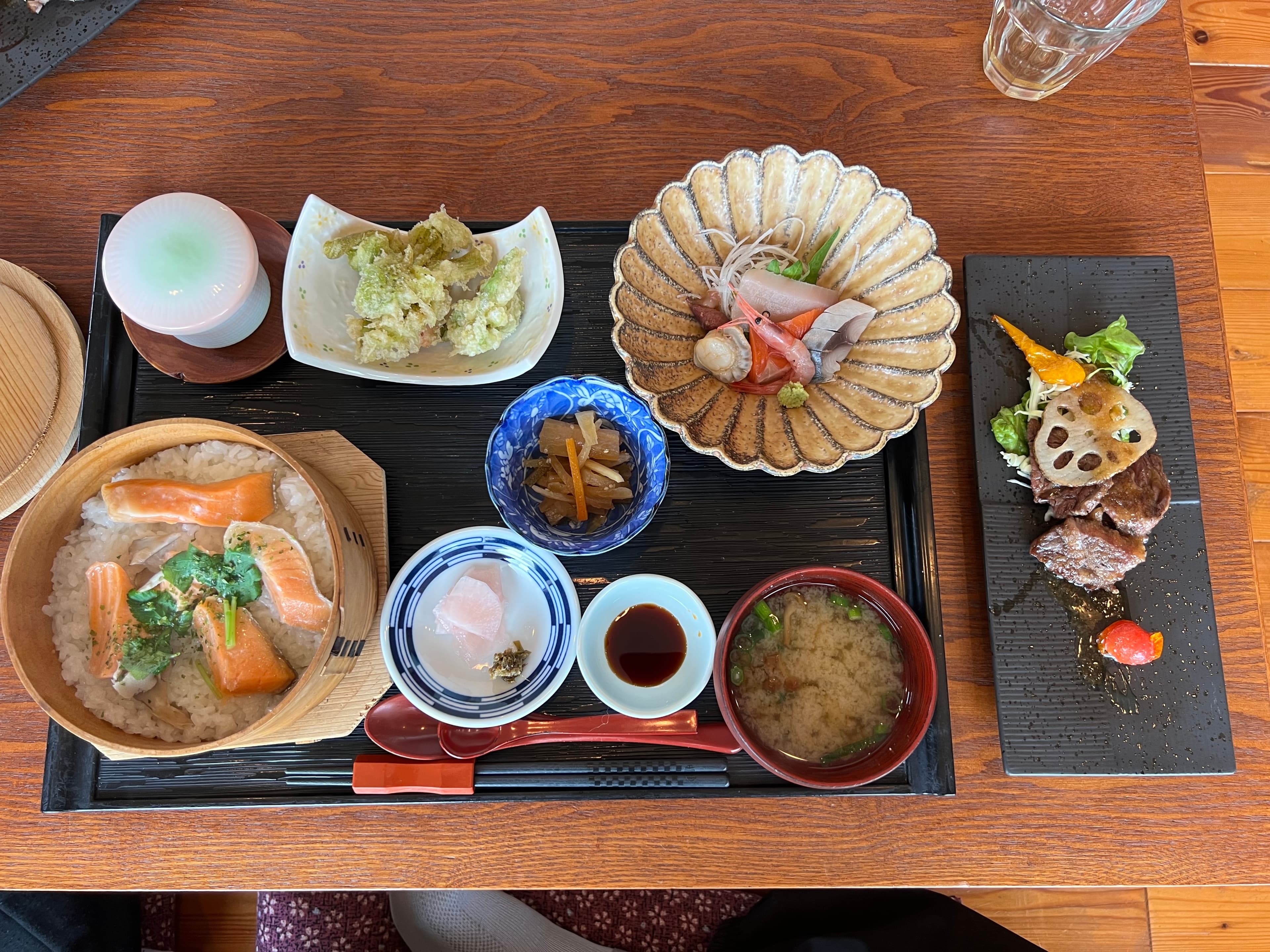
Dinner may include grilled fish, seasonal vegetables, pickles, tofu, miso soup, rice, and small dishes made with ingredients from the surrounding area. Near Lake Biwa, this might mean locally grown rice, vegetables from nearby farms, or fish connected to the lake’s food culture. In mountain regions, the menu may feature wild vegetables, mushrooms, or river fish.
The dishes are often brought out together on several small plates, making even a modest meal feel generous. The presentation may not be as elaborate as at a luxury ryokan, but the food is usually personal and closely connected to the region.
Breakfast tends to be traditional Japanese style. You might be served rice, miso soup, grilled fish, a rolled omelette, pickles, and vegetables. For travellers used to toast and coffee in the morning, it can feel like a full meal, but it is also a satisfying way to begin a day of walking or cycling.
Meal times may be fixed, particularly when only one or two people are preparing the food. Dinner might begin at 6:00 or 6:30, and breakfast may be served at a set time the following morning. This is not the kind of accommodation where you arrive late and decide what to eat afterwards, so it is important to communicate your arrival time clearly.
Many ryokan have a communal bath for guests. This may be an onsen (hot spring) if the water comes from a natural hot spring, but not every ryokan has one. In other cases, it is simply a shared Japanese-style bath using heated water.
The bathing area is usually divided by gender. You wash and rinse your body at one of the shower stations before entering the main bath. The bath itself is for soaking and relaxing, not for washing.
At a small countryside inn, the bath may be little more than a tiled room with one large tub. It will not necessarily resemble the dramatic outdoor hot springs seen in travel advertisements, but after a long day of cycling or exploring, it can still be one of the best parts of the stay.
Some smaller establishments operate the bath at specific times or ask guests to use it one group at a time. The owners will normally explain the arrangement when you arrive.
Many local ryokan have been operated by the same family for decades. The person checking you in may also prepare dinner, clean the rooms, and answer the telephone.
The owners are often an older couple or several generations of the same family. English may be limited, and the check-in process may involve handwritten forms, gestures, and a quick explanation of meal and bath times.
This can feel less polished than staying at a modern hotel, but it is also much more personal. You may be asked where you have come from, where you are going next, or why you decided to visit the area. By the following morning, the owners may already feel less like hotel staff and more like people welcoming you into their home.
The buildings themselves often reflect this long history. Floors may creak, corridors may be narrow, and bathrooms may have been added years after the original structure was built. Some rooms may feel dated rather than carefully preserved.
That is part of the distinction. A local ryokan is not necessarily a perfectly restored historic property. It is often a working family business that has continued operating while the town around it has changed.
Japan is also home to luxury ryokan that can cost tens of thousands of yen per person per night. These may include private outdoor baths, carefully designed rooms, and elaborate kaiseki (multi-course Japanese) dinners.
Countryside ryokan are often much more affordable. When dinner and breakfast are included, the overall value can be especially good. A simple room with two meals may cost less than a standard hotel room in Kyoto or Tokyo, even though considerably more hospitality and food are included.
The challenge is finding and booking them.
Some appear on Japanese reservation platforms, but others have only a basic website or an old listing with a telephone number. Their Google Maps profile may have very few photos, no booking button, and reviews written almost entirely in Japanese. In some cases, the only way to reserve is to call directly.
This can make them difficult for international visitors to access. Even Japanese travellers may need to search using the town name together with terms such as ryokan, shukuhaku (lodging), or minshuku (family-run guesthouse). Information about room availability and meal plans may not be updated online.
The lack of online visibility does not necessarily mean the accommodation is poor. It often means the business still relies on repeat customers, telephone reservations, and domestic travellers who already know the area.
A countryside ryokan is unlikely to have the convenience of a major hotel. There may be no private shower, no English-speaking receptionist, and nowhere nearby to eat after 8:00 p.m. The room may be older, and the daily schedule may revolve around the owners’ meal and bathing times.
But this is also what makes the experience distinctive.
You are not separated from the surrounding town by an international hotel lobby. You eat food prepared from regional ingredients, sleep on tatami, use the shared bath, and wake up to a breakfast that reflects everyday Japanese food rather than an international buffet.
For many visitors, this feels closer to the Japan they hoped to encounter.
Luxury ryokan can be wonderful, but the smaller local inns offer something different. They provide a glimpse into the rhythms of rural Japan and the families who have been welcoming travellers long before online booking platforms existed.
They may take a little more effort to find, but that is often part of what makes the stay memorable.